 EN
EN  ES
ES 

Lenten Reflections, February 18th, 2026
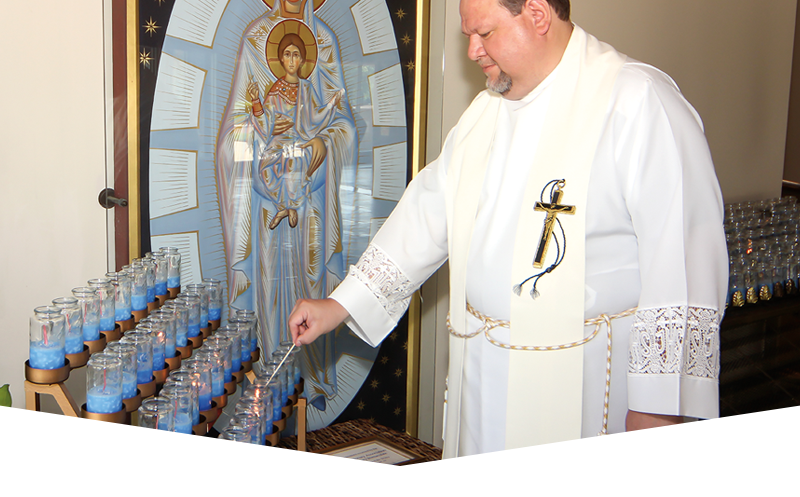
Light a Votive Candle
at the Shrine of Our Lady of the Snows

Send your Intentions to Lourdes
and reflect on the miracle of Easter

Book of Healing Prayers
Build a closer relationship with God.
Transcript of the Video Above
Daily reflections for Lenten Easter, written by Oblate Father Ron Rolheiser, OMI.
We begin the season of Lent with ashes on our foreheads. What is symbolized by this smudging? Perhaps the heart understands better than the head, because more people go to church on Ash Wednesday than on any other day of the year, including Christmas.
Why are the ashes so popular?
Well, their popularity, I suspect, comes from the fact that as a symbol they are blunt, archetypal and speak the language of the soul. Something inside each of us knows exactly why we take the ashes. Dust thou art, and into dust thou shalt return. No doctor of metaphysics need explain this.
To put on ashes, to sit in ashes is to say publicly and to yourself that you are reflective, in a penitential mode, that this is not ordinary time for you, that you are grieving some of the things you have done or lost, that some important work is going on silently inside you. You are metaphorically, and really, in the cinders of a dead fire, waiting for a fuller day in your life.
All of this has deep roots. There is something innate to the human soul that knows that every so often one must make a journey of descent, be smudged, lose one’s luster, wait while the ashes do their work.
All ancient traditions abound with stories of having to sit in the ashes before one can be transformed. We all know, for example, the story of Cinderella. This is a centuries old wisdom tale that speaks about the value of ashes. The name Cinderella itself already says most of it. Literally, it means the young girl who sits in the cinders. Moreover, as the tale makes plain, before the glass slipper is placed on her foot, before the beautiful gown, ball, dance and marriage, there must first be a period of being humbled. In the story of Cinderella, there is a theology of Lent.
The church taps into this deep well of wisdom when it puts ashes on our foreheads at the beginning of Lent.
Lent is a season for each of us to sit in the ashes, waiting while some silent growth takes place within us and simply being still so that the ashes can do their work in us.
About the author: Father Ron Rolheiser, OMI

Fr. Ronald Rolheiser, OMI, is a Roman Catholic priest and member of the Missionary Oblates of Mary Immaculate. He is a community-builder, lecturer, and writer. His books are popular throughout the English-speaking world and have now been translated into many languages. His weekly column is carried by many newspapers worldwide. Before this present position, he taught theology and philosophy at Newman Theological College in Edmonton, Alberta, for 16 years, served as Provincial Superior of his Oblate Province for six years, and served on the General Council for the Oblates in Rome for six years. From 2005 – 2020, Fr. Ron served as President of the Oblate School of Theology in San Antonio, Texas.
Support the Oblates During Lent
Your donation helps our Oblate Missionaries bring healing and hope to the poorest families around the world.